Last Updated on February 5, 2026 by Brian Kachejian
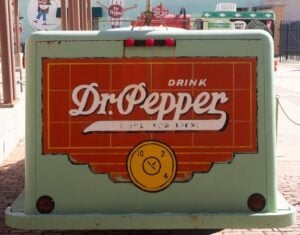
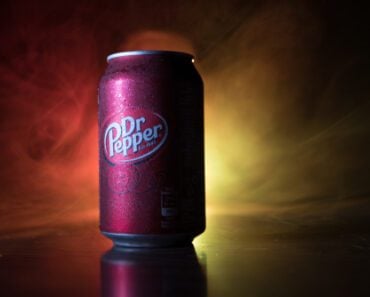
Feature Photo licensed from Shutterstock
The history of Dr Pepper, distinct among major American carbonated beverages, begins not in a boardroom in Atlanta or New York, but in the burgeoning frontier town of Waco, Texas. Created in 1885, Dr Pepper holds the distinction of being the oldest major soft drink brand in the United States, predating its most famous rival, Coca-Cola, by one year. The drink was the invention of Charles Alderton, a young pharmacist working at Morrison’s Old Corner Drug Store. Alderton, educated in England and Texas, spent his time mixing fruit syrups and carbonated water at the soda fountain, experimenting with combinations that would capture the scents of the pharmacy itself.
He eventually struck upon a blend of twenty-three flavors that patrons of the drug store found unique and invigorating. Originally referred to by locals simply as a “Waco,” the drink grew in popularity until the store owner, Wade Morrison, officially named it Dr. Pepper. The origin of the name remains a subject of folklore, with the most persistent (though likely apocryphal) theory suggesting Morrison named it after Dr. Charles Pepper, a Virginia physician whose daughter Morrison had once courted.
The transition from a local curiosity to a national commodity required business acumen that neither Alderton nor Morrison possessed in full measure. Realizing the drink’s potential exceeded the capacity of a single soda fountain, Morrison partnered with Robert S. Lazenby, a young beverage chemist and proprietor of the Circle “A” Ginger Ale Company. In 1891, they formed the Artesian Mfg. & Bottling Company, which would later evolve into the Dr Pepper Company. Lazenby was instrumental in standardizing the formula and developing the manufacturing processes necessary for mass distribution. The brand’s true national debut occurred at the 1904 Louisiana Purchase Exposition in St. Louis, Missouri. This World’s Fair was a watershed moment for American food culture, introducing the public to the hamburger, the hot dog, the ice cream cone, and the distinctively spicy taste of Dr Pepper, which was served to millions of attendees.
Throughout the early twentieth century, Dr Pepper differentiated itself through marketing strategies that emphasized both health and distinctiveness. In the 1920s, the company commissioned a study by Dr. Walter Eddy of Columbia University, who discovered that the average person’s energy levels dropped significantly at 10:30 a.m., 2:30 p.m., and 4:30 p.m. Seizing upon this scientific finding, the company launched the “10, 2, and 4” campaign, encouraging consumers to drink a Dr Pepper at these specific times to maintain vitality. This slogan became iconic, appearing on clock faces and signage across the American South for decades. During this era, the company also underwent significant trademark evolution: the period after “Dr” was famously dropped in the 1950s to improve the legibility of the logo on bottling caps and signage, resulting in the stylized “Dr Pepper” familiar today.
A critical juncture in Dr Pepper’s corporate history occurred in 1963, when a federal court ruling legally defined the beverage’s category. For years, rival Coca-Cola had argued that Dr Pepper was a cola and therefore should be subject to the exclusive bottling contracts that prohibited bottlers from distributing competing cola products. The U.S. District Court ruled that Dr Pepper was not a cola, nor a root beer, nor a fruit flavor, but rather a distinct “pepper” style beverage. This legal victory was monumental, as it allowed the company to franchise its product to independent bottlers who also distributed Coca-Cola or Pepsi. This unique “piggyback” distribution network enabled Dr Pepper to achieve near-universal availability across the United States without the capital expenditure required to build a proprietary bottling infrastructure from the ground up.
The late twentieth century saw Dr Pepper aggressively expand its cultural footprint while undergoing a series of complex corporate mergers. The “Be a Pepper” advertising campaign of the 1970s, featuring David Naughton, successfully positioned the drink as a choice for individualists and nonconformists, cementing a loyal fanbase. Corporate ownership shifted from family control to investment firms, eventually merging with the Seven Up Company in 1986. Further consolidation occurred in 2008 when the Dr Pepper Snapple Group was spun off from Cadbury Schweppes.
In 2018, the company merged with Keurig Green Mountain to form Keurig Dr Pepper, a beverage conglomerate with a massive portfolio. Despite these shifts, the brand maintained a cult following regarding its formula, particularly the version bottled in Dublin, Texas. For decades, the Dublin Dr Pepper bottling plant refused to switch from Imperial pure cane sugar to high fructose corn syrup, creating a gray market for the “original” formula. This unique arrangement ended in 2012 following a trademark dispute, after which the Dublin plant ceased production of the trademarked soda, although “Real Sugar” varieties produced by the parent company remain available.
Today, Dr Pepper remains a singular entity in the beverage world, defined by its refusal to fit neatly into the cola wars. Its proprietary blend of twenty-three flavors—rumored to include amaretto, almond, blackberry, black licorice, carrot, clove, cherry, caramel, cola, ginger, juniper, lemon, molasses, nutmeg, orange, prune, plum, pepper, root beer, rum, raspberry, tomato, and vanilla—remains a closely guarded industrial secret. While competitors have attempted to replicate the flavor profile with “spiced” or “doctor” variants, none have managed to usurp the original’s market dominance. From its origins in a Waco pharmacy to its status as a global conglomerate keystone, Dr Pepper serves as a testament to the power of unique branding and the enduring appeal of distinct, complex flavors in the American palate.
Sources
Dr Pepper Museum. “History of Dr Pepper.” Accessed February 4, 2026. https://drpeppermuseum.com/history/.
Ellis, Harry E. Dr Pepper: King of Beverages. Dallas: Dr Pepper Company, 1979.
Keurig Dr Pepper. “Our History.” Accessed February 4, 2026. https://www.keurigdrpepper.com/en/our-company/history.
Rodengen, Jeffrey L. The Legend of Dr Pepper/Seven-Up. Fort Lauderdale: Write Stuff Syndicate, 1995.
Simnacher, Joe. “W.W. ‘Foots’ Clements, former Dr Pepper CEO who transformed the brand, dies at 87.” The Dallas Morning News, October 4, 2011.
Smith, Andrew F. Encyclopedia of Junk Food and Fast Food. Westport: Greenwood Press, 2006.
Stoddard, Scott. “Dr Pepper Snapple Group formed as Cadbury spinoff.” Dallas Business Journal, May 7, 2008.
Read More: What Does Dr Pepper Really Taste Like? America’s Most Confusing Soda Explained
The History of Dr Pepper: America’s Oldest Major Soft Drink article published on RockinFoodie.com© 2026
RockinFoodie.com claims ownership of all its original content and Intellectual property under United States Copyright laws and those of all other foreign countries. No one person, business, or organization is allowed to republish any of our original content anywhere on the web or in print without our permission. All photos have been professionally taken by the rockinfoodie.com staff and are copyrighted. Photos not produced by staff are either public domain Creative Commons photos or licensed officially from Shutterstock. Any theft of our content will be met with swift legal action against the infringing websites.