Last Updated on February 3, 2026 by Brian Kachejian
Feature Photo: Licensed from Shutterstock
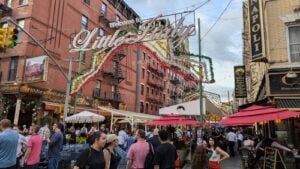
The Holy Cannoli Eating Championship is held annually in Little Italy, New York City, during the Feast of San Gennaro, one of the city’s oldest and most recognizable street festivals. The competition has been a staple of the feast since the mid-1990s, evolving into one of the most anticipated food contests on the festival calendar. Unlike destination challenges tied to restaurants, this event unfolds in the middle of a crowded urban street fair, surrounded by food vendors, live music, and dense foot traffic.
The Feast of San Gennaro takes place every September and spans multiple days, drawing large crowds to Mulberry Street and the surrounding area. The Holy Cannoli Eating Championship reflects the spirit of the festival itself, loud, fast-paced, and rooted in Italian American food tradition. The contest is staged as a public spectacle, with spectators gathered closely around the competitors, creating an atmosphere that is as much performance as competition.
The rules of the championship are simple and demanding. Competitors are given six minutes to consume as many cannoli as possible. Each cannolo consists of a rigid fried pastry shell filled with a dense ricotta-based cream. To count toward a competitor’s total, both the shell and the filling must be fully consumed. Partial cannoli or discarded filling results in the disqualification of that piece.
The technical difficulty of the contest lies in the structure of the cannoli itself. The shell is hard and brittle, requiring force to bite through, while the ricotta filling is rich and heavy, quickly creating a feeling of fullness. Unlike soft foods that can be compressed or dunked, cannoli resist manipulation. This combination slows even experienced eaters, making pacing critical.
The championship regularly features a mix of Major League Eating professionals and local amateur competitors. This pairing adds an element of unpredictability, as seasoned eaters must adapt to a food that does not lend itself easily to competitive techniques. Local entrants, often familiar with cannoli as a traditional dessert, sometimes perform better than expected against professional eaters.
Notable competitive eaters such as Joey Chestnut and Matt Stonie have participated in the event over the years, adding to its visibility and credibility within the competitive eating world. Records at the Holy Cannoli Eating Championship have exceeded thirty cannoli within the six-minute time limit, a total that underscores both the speed required and the physical challenge posed by the dessert.
Unlike endurance-based eating contests, the Holy Cannoli Championship emphasizes explosive speed and jaw stamina. Competitors must manage the physical strain of biting through repeated hard shells while preventing the rich filling from slowing digestion. Water is typically permitted, but excessive reliance on liquids can work against competitors by increasing fullness.
The setting plays a crucial role in the contest’s identity. The competition takes place outdoors, often in warm early autumn weather, with noise, crowds, and distractions surrounding the stage. This environment contrasts sharply with controlled indoor eating challenges, forcing competitors to perform under conditions that amplify pressure and fatigue.
Culturally, the contest serves as a celebration of Italian American food heritage. Cannoli are a symbol of Sicilian pastry tradition and have become a staple of Italian bakeries across the United States. Transforming the dessert into a competitive event introduces a playful element without stripping it of cultural meaning. The contest operates as both homage and spectacle.
The Holy Cannoli Eating Championship also reflects how food contests function differently in urban environments. Space constraints, crowd density, and festival scheduling shape the event’s format. There is no extended buildup or prolonged ceremony. The contest begins, unfolds rapidly, and ends within minutes, mirroring the pace of the city itself.
Media coverage of the event often focuses on its visual appeal. Rows of cream-filled pastries, rapid consumption, and animated crowds provide strong imagery. The contrast between the elegance of the dessert and the intensity of the competition adds to its appeal. This visual tension has helped the contest maintain relevance year after year.
Economically, the championship contributes to the broader success of the Feast of San Gennaro. The event draws attention to the festival, encourages foot traffic, and reinforces Little Italy’s identity as a destination for traditional Italian food. While the contest itself is brief, its presence enhances the overall experience for attendees.