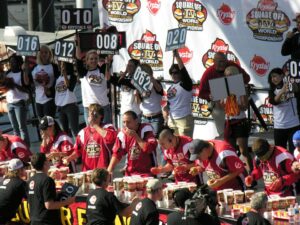
Feature Photo: Sean Russell from Knoxville, TN, USA, CC BY-SA 2.0 <https://creativecommons.org/licenses/by-sa/2.0>, via Wikimedia Commons
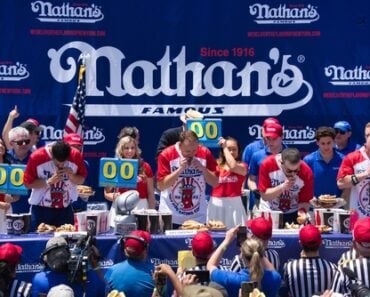
The Krystal Square Off is one of the most historically important events in competitive eating, first held in 2004 and immediately altering the sport’s landscape. Held in various locations over the years and historically associated with Chattanooga, Tennessee, the contest distinguished itself by becoming the first major televised hamburger-eating competition to rival Nathan’s Famous hot dog contest. Its arrival marked a turning point, proving that competitive eating could extend beyond hot dogs and still command national attention.
The contest centers on Krystal hamburgers, small square sliders made with thin beef patties, onions, and soft buns. While their size may appear manageable, the challenge lies in repetition and speed. Competitors must consume as many burgers as possible within an eight-minute time limit, with each burger fully eaten to count. The uniformity of the food emphasizes rhythm and efficiency.
Krystal Square Off gained legendary status during the 2000s due to the rivalry between Takeru Kobayashi and Joey Chestnut. At the time, Kobayashi was redefining competitive eating through speed and technique, while Chestnut was emerging as a dominant American challenger. Their appearances at the Square Off elevated the contest to must-watch status within the sport.
One of the most famous performances in the event’s history came when Kobayashi consumed ninety seven Krystal burgers in eight minutes. This total remains one of the most staggering hamburger records ever achieved and demonstrated the effectiveness of the techniques that had already transformed hot dog competitions. The performance set a benchmark that reinforced the Square Off’s legitimacy.
The event’s televised format played a critical role in its impact. By bringing hamburger eating into a broadcast environment, the Square Off expanded the audience for competitive eating beyond niche fans. Viewers were introduced to rivalries, records, and personalities that helped professional eating evolve into a recognizable sport rather than a novelty.
Unlike larger burgers used in restaurant challenges, Krystal sliders emphasize speed over endurance. The small size reduces chewing resistance but increases the demand for rapid swallowing and precise pacing. Competitors who misjudge tempo often fall behind quickly, as small inefficiencies compound over eight minutes.
The contest also benefited from Krystal’s regional identity. As a Southern fast food chain with a loyal following, Krystal provided a recognizable brand that resonated with audiences. This regional connection helped the Square Off feel grounded in American fast food culture rather than abstract competition.
Over time, the Krystal Square Off experienced periods of hiatus, reflecting shifts in sponsorship and broadcasting priorities. Despite these interruptions, the event’s reputation remained intact. Its historical importance ensured it remained a benchmark for hamburger-eating contests even when not actively staged.
Within competitive eating circles, the Square Off is often cited as the gold standard for hamburger competitions. Later burger-based contests adopted similar formats but rarely matched Square Off’s combination of elite talent, television exposure, and record-setting performances.
The event’s legacy extends beyond numbers alone. It demonstrated that rivalries could drive interest, that fast food chains could anchor major competitions, and that hamburger eating could command the same respect as established contests. These lessons influenced how future events were structured and promoted.
From a cultural perspective, the Square Off captured a moment when competitive eating was transitioning from spectacle to sport. Training, strategy, and professionalism were becoming visible to audiences, and the Square Off served as a stage for that evolution.
As part of this series, the Krystal Square Off represents a foundational chapter in competitive eating history. Its influence persists not because it is the largest or longest-running event, but because it reshaped what the sport could be. Even with gaps in its timeline, it remains a reference point against which all hamburger-eating contests are measured.