Feature Photo Licensed From Shutterstock
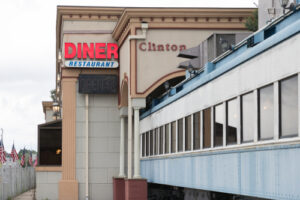
The 8th Wonder Challenge is hosted at the Clinton Station Diner in Clinton, New Jersey, and since its introduction in 2004, it has stood as one of the most extreme food challenges ever attempted in the United States. Unlike speed-based eating contests or spice endurance challenges, this event is defined almost entirely by scale. The challenge centers on a single hamburger so large that it pushes the limits of both human consumption and physical logistics.
At the heart of the challenge is a burger weighing 105 pounds, measuring approximately 28 inches in diameter and 11.5 inches high. The burger is constructed with a massive beef patty, layered inside an oversized bun designed to support the meat’s weight and density. The proportions are deliberate. The bun is not a token component but a structural element that significantly increases the challenge’s difficulty.
The rules are straightforward but unforgiving. A team of up to ten participants is given one hour to consume the entire burger. Every portion must be eaten for the challenge to be considered complete. Leftover meat or bun results in failure, regardless of how close the team comes to finishing. No substitutions are permitted, and assistance beyond the designated team members is not allowed.
The prize for completing the challenge is five thousand dollars, a sum that reflects both the difficulty of the task and the diner’s confidence that the payout will rarely, if ever, be claimed. Despite the financial incentive, successful completions are virtually nonexistent. The challenge has become legendary precisely because of its improbability rather than its accessibility.
What makes the 8th Wonder Challenge distinct is that it is not designed around speed, pain tolerance, or individual endurance. It is a test of coordination, pacing, and physical capacity on a scale beyond typical competitive eating parameters. Even experienced eaters quickly encounter limitations imposed by density rather than volume. The meat’s thickness and richness create a rapid sense of fullness that cannot be overcome through technique alone.
The Clinton Station Diner itself plays an important role in the challenge’s identity. The diner operates out of a historic converted railcar, a structure that evokes classic American roadside dining culture. This setting contrasts sharply with the modern extremity of the challenge, grounding it in nostalgia while presenting something far beyond traditional diner fare. The visual impact of a 105-pound burger being served in a classic railcar diner adds to the challenge’s mythos.
Since its debut, the challenge has drawn attention from food enthusiasts, competitive eaters, and media outlets. Photographs of the burger alone are often enough to capture interest. The sheer size of the dish creates an immediate sense of disbelief, making it one of the most photographed food challenges in the country. In many cases, teams attempt the challenge more for the experience than for any realistic expectation of success.
Psychologically, the 8th Wonder Challenge appeals to a specific type of participant. It attracts groups rather than individuals, shifting the focus from personal endurance to collective effort. Teams often approach the challenge as a shared ordeal, framing participation as a story to be told rather than a competition to be won. The improbability of success becomes part of the appeal rather than a deterrent.
The challenge also taps into a distinctly American tradition of excess as spectacle. Oversized portions have long been used to signal abundance, value, and bravado in American food culture. The 8th Wonder Challenge exaggerates these traits to an extreme, transforming a familiar item, the hamburger, into something bordering on architectural. The name itself reinforces this framing, positioning the burger as a modern monument rather than a meal.
From a practical standpoint, the logistics of producing the burger are significant. Preparing a patty of this size requires specialized equipment, extended cooking time, and careful handling. The diner’s willingness to maintain the challenge over decades speaks to its role as a signature attraction rather than a gimmick. The challenge is not rotated or refreshed. Its permanence reinforces its reputation.
Unlike limited-time promotions or viral challenges, the 8th Wonder Challenge does not rely on urgency. It is always available, waiting for anyone willing to attempt it. This permanence paradoxically increases its legend. The challenge feels timeless rather than fleeting, more like a landmark than a promotion.
Health considerations are implicit in the challenge’s design. The quantity of food involved makes completion unrealistic for most participants, and the diner does not present the challenge as a casual activity. Its framing emphasizes difficulty and improbability, discouraging impulsive attempts. This positioning distinguishes it from challenges that downplay risk or discomfort.
Over time, the challenge has become part of the diner’s identity. Clinton Station Diner is not just a place that serves food but a destination known nationally for this singular feat. The challenge draws visitors who might otherwise never travel to Clinton, New Jersey, turning the diner into a point of pilgrimage within food challenge culture.
The endurance of the 8th Wonder Challenge lies in its honesty. It does not promise easy rewards or accessible victory. It presents an impossible-seeming task and lets that impossibility speak for itself. The challenge’s reputation rests not on winners but on those who tried and failed, reinforcing its status as one of the most formidable food challenges ever created.
Within the broader landscape of legendary food contests, the 8th Wonder Challenge represents the extreme end of size-based challenges. It is not about pain, speed, or luck. It is about confronting physical limits in a way that is immediately visible and undeniably overwhelming. That clarity is what has allowed it to remain relevant long after many other food challenges have faded.