Feature Photo by a katz Licensed from Shutterstock
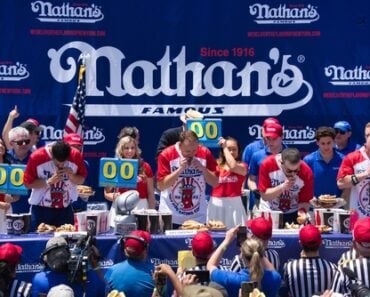
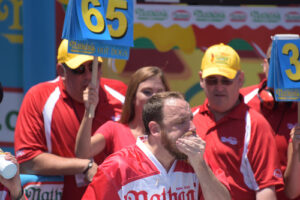
The Nathan’s Hot Dog Eating Contest is held every year on July 4 at Nathan’s Famous flagship location in Coney Island, New York, and it has become one of the most recognizable food competitions in the world. The contest traces its origins to 1916, the same year Nathan Handwerker opened his original hot dog stand on Surf Avenue. While aspects of the earliest contest accounts have been debated over time, the event became firmly established as an annual Independence Day tradition in the early twentieth century and has been held consistently for decades.
What distinguishes the Nathan’s contest from other eating competitions is its combination of location, timing, and ritual. Coney Island has long been associated with spectacle, excess, and public entertainment, making it a natural setting for an event built around endurance and consumption. Holding the contest on July 4 ties it directly to American identity and celebration, reinforcing its status as a national ritual rather than a novelty event. The contest has become as much a part of the holiday calendar as fireworks and parades.
The contest format is tightly controlled. Competitors are given a fixed amount of time to consume as many hot dogs and buns as possible. Under modern rules, the standard competition time is ten minutes, and both hot dogs and buns must be consumed for a hot dog to count toward a competitor’s total. Water and other approved beverages may be used to aid swallowing, but food may not be discarded. Judges closely monitor competitors to ensure compliance, and violations can result in penalties or disqualification.
The event is sanctioned by Major League Eating, the governing body that oversees professional competitive eating. Major League Eating was founded in the late nineteen nineties and introduced standardized rules, rankings, and prize structures to formalize the sport. The Nathan’s contest became its premier championship event, elevating competitive eating from fringe entertainment into a regulated professional competition with national and international visibility.
Over time, the contest produced dominant competitors who reshaped public perception of what was possible. In the early two thousands, Takeru Kobayashi emerged as a transformative figure, introducing techniques that emphasized efficiency, bun compression, and pacing. His performances dramatically increased winning totals and forced other competitors to adapt their strategies. Kobayashi’s success marked a turning point in the evolution of competitive eating, shifting it from spectacle toward performance discipline.
That evolution reached its peak with Joey Chestnut, who became the most dominant competitor in the contest’s history. Chestnut won his first Nathan’s title in 2007 and went on to claim numerous championships, setting multiple world records and consistently pushing totals beyond previous benchmarks. His performances established a new standard for elite competitive eating and made him the central figure of the contest’s modern era.
Chestnut’s relationship with the Nathan’s Hot Dog Eating Contest briefly fractured in 2024, when he was excluded from competing after entering into an endorsement agreement with Impossible Foods, a company that produces plant-based hot dogs. Nathan’s Famous has long enforced exclusivity requirements tied to the contest, and the agreement was viewed as a conflict with the brand’s sponsorship rules. As a result, Chestnut was not permitted to compete in the 2024 contest despite his ongoing status as the sport’s most recognizable figure. The decision drew widespread attention and debate, underscoring how closely the contest is tied to brand identity as well as competition.
Following the 2024 contest, discussions continued between Chestnut and Nathan’s representatives regarding the future of his participation. The dispute was ultimately resolved, and Chestnut was cleared to return to the competition the following year after addressing the sponsorship conflict. His absence and subsequent return highlighted the increasingly professional and commercial nature of competitive eating, where athletes operate within sponsorship frameworks similar to those found in traditional sports. The episode also reinforced Chestnut’s central role in the contest’s history, as his exclusion alone was enough to alter the narrative of an event otherwise defined by continuity.
The contest includes separate men’s and women’s competitions, each with its own champions and records. In recent decades, the women’s competition has gained increased visibility, with dominant competitors establishing sustained winning streaks and drawing national attention. Prize money is awarded to top finishers, and winners receive both cash prizes and symbolic recognition tied to the contest’s long-standing traditions.
Media coverage plays a central role in the contest’s cultural footprint. The event is broadcast nationally on television and streamed digitally, reaching millions of viewers each year. Commentators narrate the competition with the language and pacing of traditional sports broadcasts, tracking pace, projecting final totals, and referencing historical comparisons. This presentation reinforces the idea that the contest is an athletic competition rather than a novelty act.
Culturally, the Nathan’s Hot Dog Eating Contest occupies a unique space in American life. Hot dogs are deeply embedded in American food culture, associated with baseball games, backyard cookouts, and public gatherings. Consuming them in extreme quantities on Independence Day transforms a familiar food into a symbol of abundance, endurance, and spectacle. The event reflects a specific strain of Americana that blends celebration with excess in a highly visible public setting.
The contest’s longevity is unusual in modern food culture. Many promotions fade once novelty wears off, but Nathan’s has endured for more than a century. Its success lies in its consistency. The location, date, rules, and visual presentation have remained largely unchanged, allowing the contest to become predictable in a way that encourages anticipation rather than boredom.
Economically, the event benefits both Nathan’s Famous and the surrounding Coney Island area. The contest draws large crowds, generates tourism, and produces extensive media exposure. For Nathan’s, the contest reinforces brand identity by permanently linking its product to a globally recognized event. That association has proven durable across generations, surviving shifts in media, culture, and consumer behavior.
What ultimately sets the Nathan’s Hot Dog Eating Contest apart from other food competitions is that it exists independently of promotional cycles. It is not tied to a new product launch or a limited-time offer. It functions as an event in its own right, anchored by tradition rather than marketing urgency. That distinction allows it to transcend novelty and remain relevant year after year.
In the broader landscape of food contests, Nathan’s serves as the benchmark. It established the template for modern competitive eating and demonstrated how food, ritual, and spectacle can merge into a lasting cultural institution. Its continued presence on the national calendar reflects the enduring appeal of shared rituals rooted in place, history, and performance.